Danny Boyle and Alex Garland have reunited at long last after their infamous falling out due to the ending of 2007’s film Sunshine to create a unique and philosophical sequel 28 years later. Set nearly three decades after 28 Days later, it’s revealed that the rage virus was in an unlikely turn of events fought back in Europe and the United Kingdom is now a quarantine zone enforced by a coalition of naval vessels. Conjuring up images of both the Covid lockdowns and the ongoing blockade of the Gaza strip by Israel. The stranded Swedish soldier Erik (played by Edvin Ryding) even calls the locals “natives” and is shocked by their ignorance of technology.
Unsurprisingly much of the mainland has been reduced to endless wilderness, crumbling buildings and masses of infected. Though civilisation remains intact in various enclaves like in Lindisfarne where the main character Spike (Alfie Williams) lives. Understandably the level of technological and productive capacity is limited, with minimal use of scarce resources required for these pockets of civilisation to survive. Thematically this is demonstrated not only by various messages reminding people to think before using resources but also through the intercutting of modern British people using bow and arrows and footage of medieval warriors fighting in the same fashion. The symbolism is heavy handed but it definitely leaves no room for misinterpretation. Further punctuating this is a generous use of freeze frames during the action sequences and when characters have sudden emotional outbursts, showing that aggression is not just an aspect of the rage virus itself but the conditions of the uninfected is shaping them to be more violent as well.
The first half of the movie is animated by a sense of pragmatism with Spike’s father Jamie (Aaron Taylor-Johnson) taking him out to the mainland via the tidal bridge to scavenge and get his first kill. Whenever Spike comes up against a violent situation that causes him to look away Jamie forces him to desensitise himself and proceed on. Inevitably the stakes are increased when they come across an alpha infected which is far larger, faster and more intelligent than the regular ones and they have to hold up in a crumbling building for a night before narrowly escaping the building itself as it falls apart. The alpha pursues them relentlessly to the gates of Lindisfarne and they only narrowly escape. This portion of the film establishes two facts, 1: humans are adapting to the lack of technology and 2: the infected are also changing, with both the alpha showcasing increased intelligence and the child Slow Low (a new form of infected that craws on the ground) that Spike stops Jamie from killing foreshadowing events later in the film.
The party that is held in Spike’s honour for his first scavenge and kill is where the real story begins. Spike, overcome by the drinking and atmosphere of the party, leaves and observes his father cheating on his mother (who earlier on is established as very ill). On the mainland Spike had asked his father about a fire in the distance and upon further questioning finds out it’s a former General Practitioner named Dr. Kelson (Ralph Fiennes). Spike takes it upon himself to bring his mother Isla (Jodie Comer) to Dr. Kelson for treatment. The film’s use of Isla as the main plot point to drive the narrative and Spike’s growth as a character from a naïve boy to more of a young man by the end is predictable however Jodie Comer’s performance is excellent, showcasing great range as she sometimes treats Spike as her son, sometimes her father and goes from extremely competent to ailing from one scene to the next.
The film has an intimate quality to it with the characters being surrounded by wide landscapes and frenetic violence that requires teamwork to survive and the cinematography is very beautiful. iPhones were prominently used to shoot the film in a callback to the VHS quality of the original film but this was clearly a marketing exercise and is overplayed given the range of camera technology used.
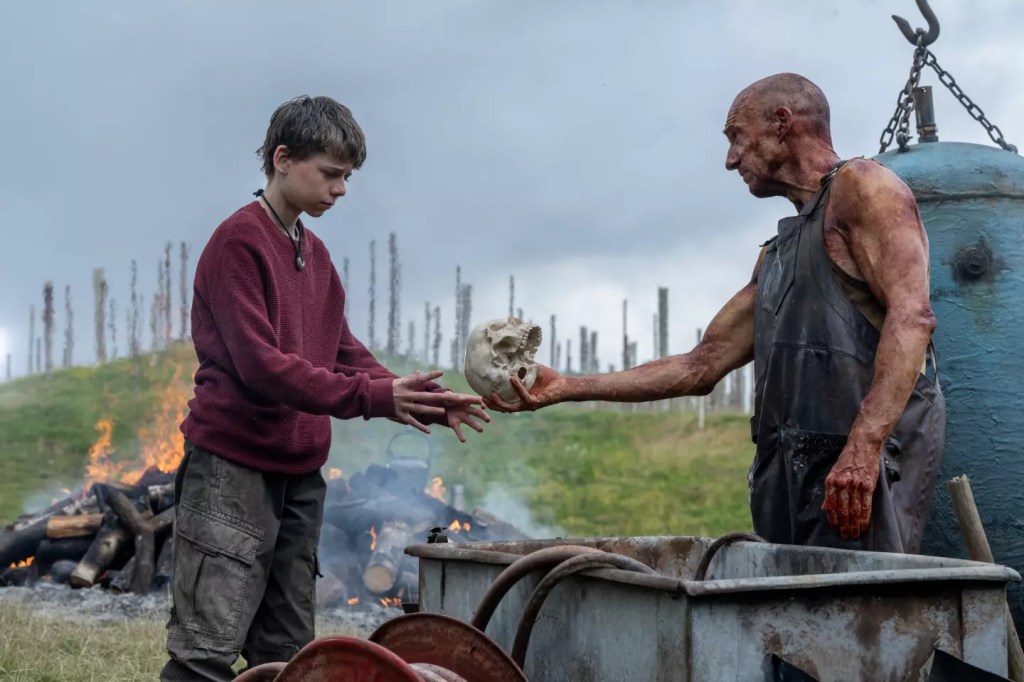
The story takes a sudden turn when Isla helps a pregnant infected give birth to a child which isn’t infected. This sets up their meeting with Dr. Kelson who sees less of a difference between those infected by the rage virus and the uninfected. The philosophical turn of the film starts here and he introduces Spike to the concepts of Memento Mori “remember you must die” and Memento Amori “remember love”. An approach he embodies not only by his unwillingness to outright kill those infected by the rage virus (instead he immobilises them for a time with a blowpipe) but also with his tower of skulls that he’s constructed out of anyone human or infected that’s perished.
As is suspected, Isla has incurable cancer that’s metastasised and Dr. Kelson euthanises her with her consent. With voluntary euthenasia being such a political sticking point in various countries this is bold subject matter. Ralph Fiennes is able through his outstanding performance to humanise this obsessive iodine applying, skull collecting, former GP and make as persuasive a case as could possibly be made for euthenasia given the symbolism. It must be noted that the cinematography when Isla’s skull is added to the skull tower is some of the most exquisite in the film and it doesn’t treat the topic lightly, but with the respect it deserves.
Spike goes home a changed person and ventures out on his own after leaving the baby at Lindisfarne. Dangers persist however and Spike finds himself under attack by more infected than he can handle. The final scene in the movie showcases a grown Jimmy, the young boy at the beginning of the film who narrowly escapes the infected, coming to the rescue. He’s accompanied with a gang of blond haired followers who are clearly modeled after his childhood friends that died so long ago. The issue with this scene isn’t that it isn’t an effective foreshadowing of the next film, it’s more that the tonal shift is so stark that it diminishes the gravity of what the film itself had just accomplished. It would have been more powerful to just show Jimmy and not shift to the frenetic combat that follows, instead placing that at the beginning of the next film.
Nevertheless the film itself is very much worth watching and will be looked upon as a bold and ambitious addition to the franchise in the years to come. People who moralise art will have some trouble in the second half of the move but I’m confident it’ll win people over eventually.
Watch it if you love the franchise and enjoy intimate philosophical films.
Give it a miss if watching a film about euthanasia isn’t something you can stomach.
Movie Name: 28 Years Later
Director: Danny Boyle
Cast: Alfie Williams; Jodie Comer; Ralph Fiennes; Aaron Taylor-Johnson; Edvin Ryding; Jack O’Connell; Christopher Fulford;
Chi Lewis-Parry
 Outer Layer