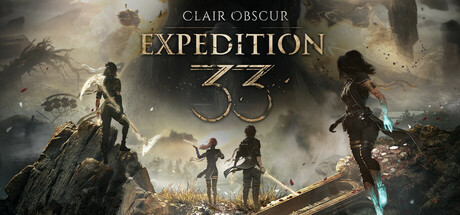
Clair Obscur: Expedition 33 by Sandfall Interactive is one of those special games that only comes along once every few years. The tale of how the game was created is as interesting as the actual game itself. Sadly there’s no room to include this in the review but suffice to say the idea that a relatively small team could create a game that’s superior in almost every way to current AAA output is remarkable.
Expedition 33 starts in the city of Lumiere, which was partially destroyed and flung into the sea by a past event called The Fracture. Ever since then an otherworldly power called The Paintress has slowly been whittling down the population of Limuere year by year with an event the locals call The Gommage. Each year everyone of a certain age vanishes, and every year the age at which this happens gets lower by one year. Some choose to live out their last year in peace whilst others join an expedition in an attempt to stop The Paintress. This time everyone aged 34 is preparing to pass away in the gommage, setting the game up for the 33rd Expedition. The game starts with you playing as Gustave who rushes to see his former lover Sophie one last time before she passes away. The expedition then leaves Lumiere for the continent, with an uncertain fate awaiting them.
The game itself is a fusion of French aesthetics and cultural references and JRPG mechanics. Combat is a rich mixture of turn-based and real-time combat that keeps you entertained for the entire game. General attacks and special abilities are turn-based, whereas free-aiming, dodging and parrying are all real-time. Each character has a different set of abilities and battle systems that aids in replayability, whether it be Verso’s tiered attack system which rewards successful attacks, dodges, and parry’s to Luna’s more traditional offensive magic and healing abilities to the more absurd Monoco who collects the feet of defeated enemies, that allows him to transform into them during combat.
The parrying and dodging system can be difficult without being infuriating. Though some later game combo’s from enemy NPC’s are too long, leading to situations where a single miss can ruin a high level boss battle. The best way to describe the system is how people talk about Sekiro’s parrying system: it’s more of a rhythm game than anything else.
Environments are explorable in third person and you’ll rarely find yourself getting lost as the maps are tightly designed. Largely focusing on getting you from one story beat to the next. The exception to this is some of the platforming areas of the game – which whilst mostly optional – aren’t really enjoyable. It feels like the developers included them more as a meme than anything (the same can be said for the volleyball mini games). The overworld map is full of interesting areas to explore and entices players by showing locations they’ll be able to traverse at later points in the game when more exploratory abilities are unlocked.
The game already demands great appraisals based on its aesthetics, amazing soundtrack and excellent combat system. What really elevates it however, is a narrative that’s grounded in wonderfully written emotional relationships and a climax consisting of both personal (familial tragedy) and existential challenges. I won’t spoil where the game goes but needless to say that this is the best major RPG coming out of the west since Baldur’s Game 3. I believe it’s a shoo-in for game of the year. Every single component is executed to a level of quality that puts most major releases to shame. The game’s focus and lack of bloat demonstrates that Sandfall Interactive is a developer with real vision. That’s not even to mention the game’s breakout character, Esquie, a companion of Verso’s, whose personality is the most infectious and enjoyable I’ve discovered in years.
Who should play: Everyone that enjoy’s RPG’s and good writing
Who shouldn’t play: People who don’t like turn based combat (play it anyway)
Director: Guillaume Broche
Writers: Jennifer Svedberg-Yen; Guillaume Broche; Victor Deleard
Developer: Sandfall Interactive
Publisher: Kepler Interactive
 Outer Layer